How to Measure a Florida Lobster: Legal Size & the 3-Inch Rule
A Florida spiny lobster is legal only if its carapace measures more than 3 inches, and the law says you have to prove it with a gauge before the lobster ever leaves the water. That one measurement is the difference between a keeper and a citation, and it trips up more new divers than anything else, usually because they measure the wrong part or wait until they're back on the boat. Here's exactly what to measure, how to do it in the water, and the handful of related rules that keep your catch legal.
Download free today
100+ spots free to start. Waypoints are a one-time purchase.
The rule: a carapace over 3 inches
Florida's recreational size limit for spiny lobster is a carapace larger than 3 inches, and it's measured in the water (FWC spiny lobster regulations). A few details matter:
- It has to be greater than 3 inches. A carapace right at 3 inches or under is a short and goes back.
- It's the carapace, not the tail and not the overall length. Two lobster with the same total length can measure very differently at the carapace.
- The measurement happens before the lobster goes in your bag, while you're still in the water, not later on the boat.
This is the number FWC officers check first, and undersize lobster are one of the most common citations of the season. It's worth getting right every single time.
A quick tour of lobster anatomy
The whole rule hinges on telling one part from another. Here's a Caribbean spiny lobster, labeled top to tail:
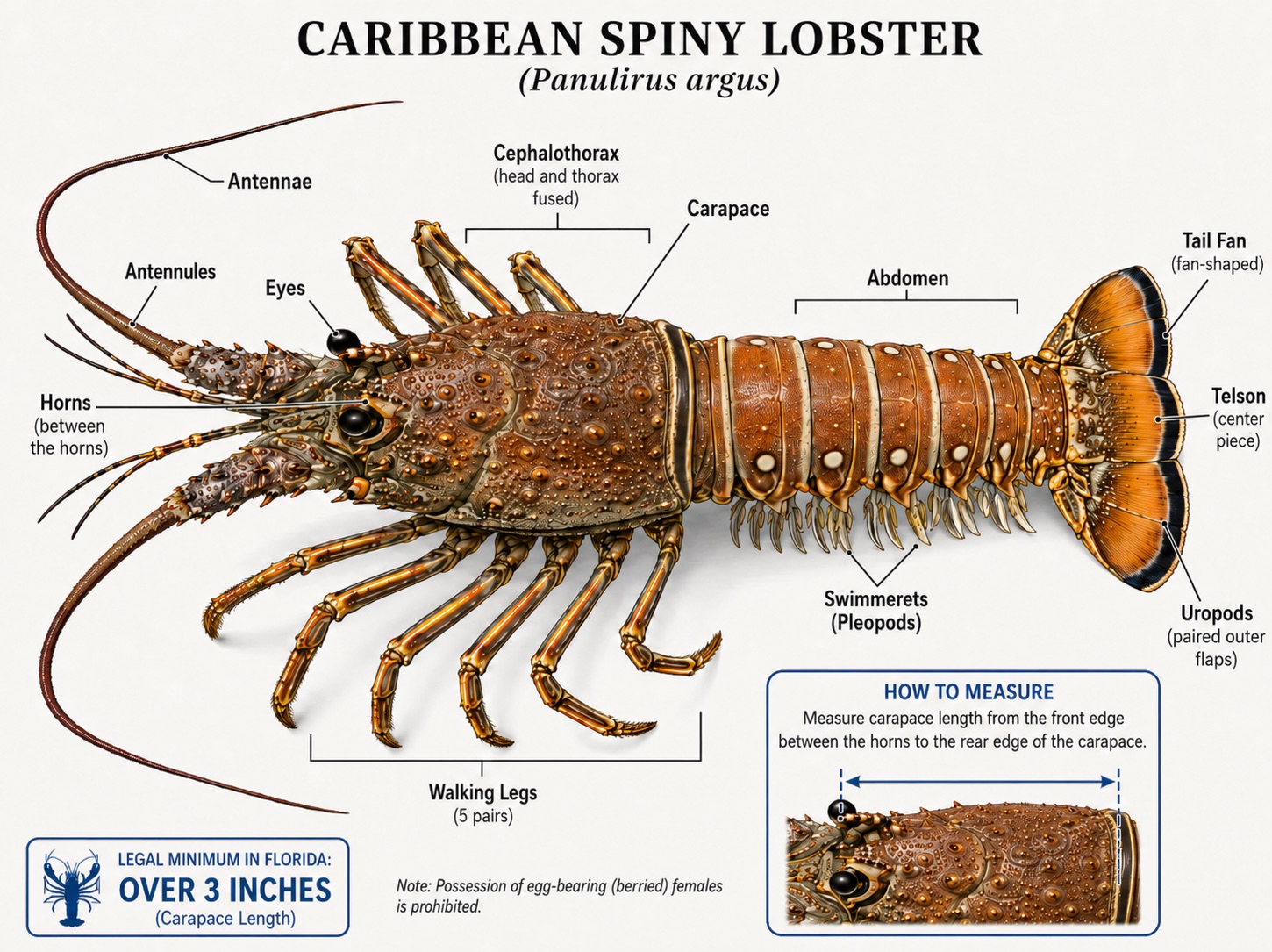
The parts that matter most for staying legal, front to back:
- Antennae: the two long, spine-covered feelers out front. They're the lobster's main defense, whipped and jabbed at predators, and they're never part of the measurement.
- Rostrum (the horns): the two forward-pointing spines above the eyes, at the very front of the carapace.
- Eyes: on short stalks just behind the horns.
- Carapace: the large, hard, shield-shaped shell over the head and midsection, from the horns back to where the tail begins. This is the only part you measure.
- Walking legs: five pairs, tucked under the carapace.
- Abdomen, or the "tail": the segmented rear section, and the part you eat. It does not count toward legal size.
- Tail fan: the flat, fanned plates at the very tip.
- Underside of the tail: where a female carries her eggs. Flip every lobster and check here, because an egg-bearing female is always off-limits.
Two parts do all the work in this guide: the carapace you measure, and the tail you don't. Keep those straight and you're most of the way there.
What to measure: the carapace, front to back
You measure the carapace, and only the carapace, going from one specific point to another:
- Start at the forward edge of the carapace, in the small notch between the two horns (the rostrum) that stick out above the eyes. You measure to the bony edge, not out to the tips of the horns and not the soft tissue.
- Finish at the rear edge of the carapace, the back edge of that shield where the tail begins.
What does not count: the horns themselves, the long antennae, and the entire tail. Measuring the tail or the whole animal is the classic beginner mistake, and it makes a short look legal. Carapace only, front notch to back edge, straight down the middle.
How to measure a lobster in the water, step by step
You're required to carry a lobster gauge and keep it on your person while diving (FWC). Most are a simple metal or plastic tool with a 3-inch opening or a set of jaws. Before you rely on one, though, make sure it actually measures true.
Not every gauge is accurate. A cheap or old one can be off straight from the package, and plastic gauges in particular warp, shrink, and flex over time. A gauge that reads short makes an undersize lobster look legal, and that mistake is on you at the citation. Before the season, hold your gauge against a known ruler and confirm the opening is a true 3 inches (a hair over is the safe side). Better yet, buy one solid metal gauge and use it for life: it stays accurate and won't warp.
Here's the routine:
- Get control of the lobster first. Bring it up from the structure and get a solid grip across the back of the carapace, keeping your hand clear of the spiny horns and the tail.
- Set the gauge at the front. Seat the fixed end of the gauge in the notch between the horns, at the forward edge of the carapace.
- Read it to the back. Look at where the rear edge of the carapace falls against the gauge. If the carapace extends past the 3-inch mark, it's legal. If it's inside the mark, it's short.
- Decide in the water. Legal lobster go in the bag. Shorts go straight back to the bottom, unharmed. Do this every time, on every lobster, before it joins the others.
If a lobster is borderline and you can't clearly see it clear the mark, release it. A borderline short is not worth a citation, and it will be legal (and bigger) next season. Measuring in murky water or current is hard, so give the benefit of the doubt to the lobster.
Keep them whole: the tail rule
Florida requires spiny lobster to be landed in whole condition. Separating the tail from the body is prohibited while you're on the water, and you can only break them down once you're on land (FWC). There are two reasons this rule exists: a loose tail can't be measured, and it hides whether the lobster was a legal, non-egg-bearing animal. So resist the urge to wring tails at the cleaning station on the boat. Keep every lobster intact until you're back on shore.
Shorts and egg-bearing females always go back
Two kinds of lobster are never legal to keep, no matter the size:
- Undersize lobster (shorts): anything with a carapace of 3 inches or under. Release them gently at the bottom.
- Egg-bearing (berried) females: the harvest or possession of an egg-bearing spiny lobster is prohibited. Flip every lobster and check the underside of the tail. If you see the mass of orange or dark eggs, she goes back, and it's illegal to scrub or strip the eggs to keep her (FWC). Those big breeders are also the most valuable animals in the water, which is the whole point of the conservation guide.
The rest of the rules in one place
Measuring is one piece of staying legal. The others:
- Bag limits: 6 per person per day in Monroe County and Biscayne National Park, and 12 per person elsewhere during mini-season (6 in the regular season). Full detail in the rules guide.
- License and permit: you need a saltwater fishing license and a lobster permit unless exempt. See do you need a license to lobster in Florida.
- Season: mini-season is the last consecutive Wednesday and Thursday of July, and the regular season runs August 6 through March 31. See the season dates.
Get the gauge habit down and the rest falls into place. Measure every lobster, in the water, carapace only, and when it's close, let it go.
Know the rules and the spots before you dive
3,000+ proven spots, no-take zones, and 4,500+ Florida artificial reefs, all offline. Waypoints are a one-time purchase.
Frequently asked questions
What is the legal size for lobster in Florida?
A spiny lobster is legal only if its carapace is larger than 3 inches. The carapace is the hard shell over the head and midsection, measured from the forward edge between the two horns above the eyes, along the middle, to the rear edge of the carapace. It's measured in the water, the tail doesn't count, and anything 3 inches or under goes back.
Do you have to measure lobster in the water in Florida?
Yes. You must carry a measuring device and measure every lobster in the water before it goes in your bag, with a gauge on your person while diving. Lobster must also be landed whole: separating the tail is prohibited on the water, and tails come off only once you're on land.
How do you measure a spiny lobster carapace?
Seat the gauge at the forward edge of the carapace, in the notch between the two horns above the eyes, and read it to the rear edge of the carapace where the tail begins. Don't include the horns, antennae, or tail. Over 3 inches is legal; 3 inches or under goes back.
Are lobster gauges accurate, and how do I check mine?
Not all of them are. A cheap or old gauge can read off, and plastic gauges especially warp and shrink over time, which can make an undersize lobster look legal. Before you rely on a gauge, hold it against a known ruler and confirm its 3-inch opening is a true 3 inches, ideally a hair over. A solid metal gauge stays accurate and won't warp, so it's worth buying one good one and keeping it for life.
About Lobsterly
Lobsterly is built by divers, for divers, as the ultimate field guide to lobstering in Florida. The app maps 3,000+ proven spots from Haulover Inlet to Key West, every no-take zone, and 4,500+ Florida artificial reefs, all offline. Waypoints are a one-time purchase, never a subscription. We keep these guides current and check the regulations against the FWC.
Related guides
Regulations change, so always confirm the current rules on the FWC spiny lobster page before you dive. Last updated July 2026.
Ready to dive in?
Install Lobsterly and limit-out on your next trip.
Have questions first? Read the Support & FAQ.